striking
Oblique Kick in MMA: What It Is, Rules, and Training Limits
Understand the oblique kick in MMA: definition, rule variations, noncontact practice, coach-supervised pad work, limitations, and a practical decision worksheet.
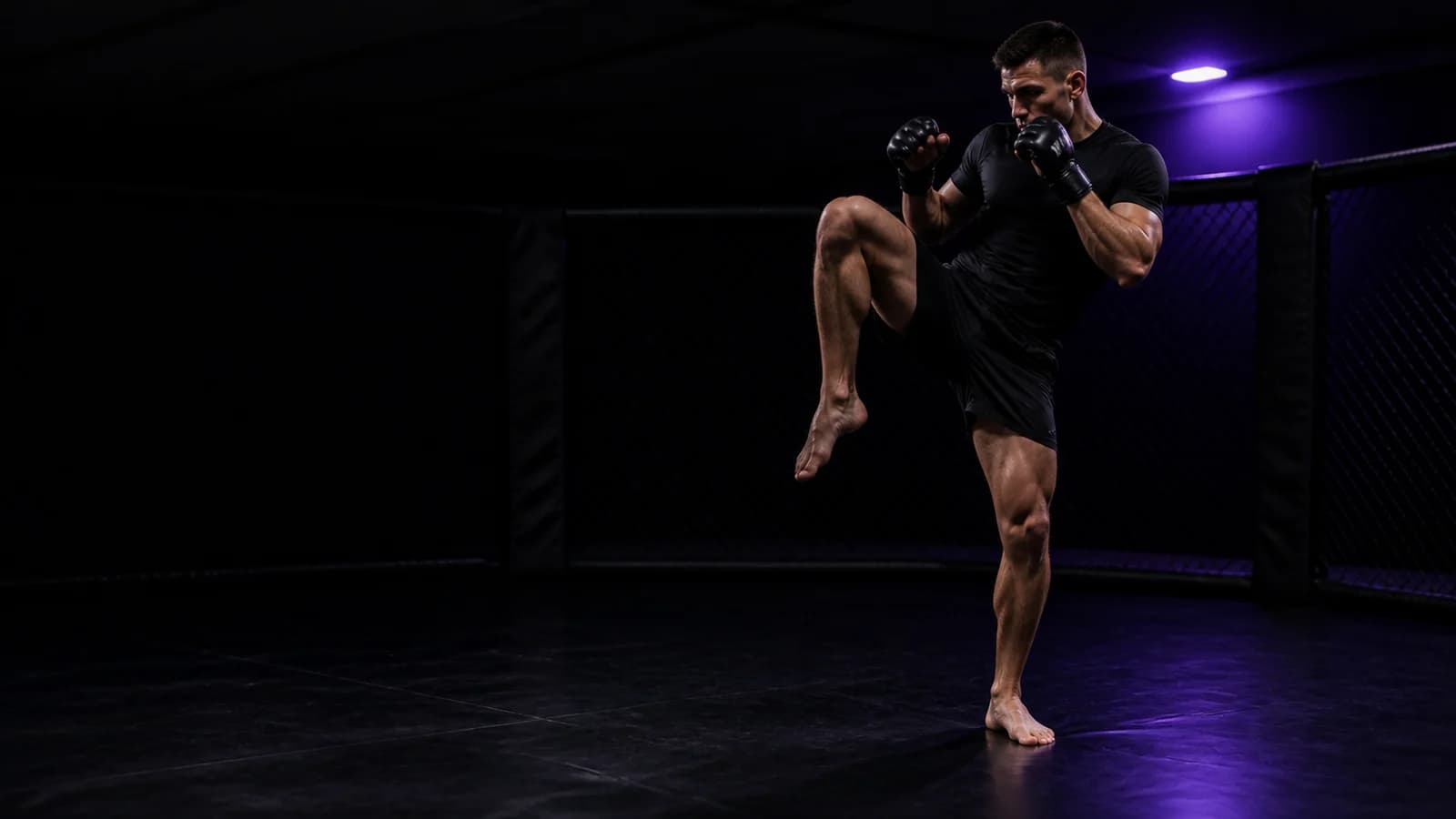
An oblique kick in MMA usually means a push-style kick directed downward or diagonally toward the opponent's lower limb. It differs from a round low kick, which follows a swinging path. The name is common coaching language, not a complete rule definition.
The practical answer has two parts: competition rules determine what officials permit in a bout, while your coach and training partner determine what you may practise together. Do not infer sparring permission from a professional fight clip. For learning, keep a person’s knee out of the drill and discuss the technique with a qualified MMA coach.
Is the oblique kick legal?
There is no universal answer covering every professional, amateur and youth event. The ABC's published professional MMA foul list does not prohibit an “oblique kick” by that name. That observation does not settle every application of the rules, the opponent's position or a particular commission's requirements.
Start with the Association of Boxing Commissions' rules directory, then find the document the organizer says applies to your event. Distinguish the professional rules from amateur recommendations and local rules.
Version matters. On 31 August 2026, the directory links to an August 2026 amended MMA document. Its cover specifies a requested November 2027 implementation date for the August 2026 changes. A recently uploaded document therefore does not, by itself, prove that every change already governs your bout.
Ask the organizer or relevant regulator which version applies. Keep the answer with the event documents. If the explanation remains unclear, do not add an ambiguous technique to your competition plan while waiting for clarification.
Why the technique attracts concern
The point of concern is proximity to a vulnerable joint, not whether a kick leaves a visible mark. A training partner cannot make an uncontrolled attempt harmless simply by agreeing that it will be light.
Do not use protective padding, reduced effort or a successful earlier repetition as proof that contact near a partner's knee is safe. Likewise, an impressive slow-motion clip cannot reveal the force, discomfort or later consequences of the contact.
This guide does not provide an impact angle, anatomical target or progression for striking a live knee. If you want to understand the movement, ask your coach to demonstrate it without exposing another person's leg to contact.
Distinguish the names you hear
Coaches sometimes use different labels for related movements. Before practising, clarify the movement rather than assuming that everyone means the same thing by “oblique,” “push kick” or “low kick.”
| Term you may hear | Broad distinction | What to clarify |
|---|---|---|
| Oblique kick | Downward or diagonal push-style lower-limb kick | Which movement does this coach mean, and what training limits apply? |
| Round low kick | Swinging kick directed toward a lower target | Which targets and contact levels does this session permit? |
| Teep or push kick | A pushing action, often discussed separately from round kicks | What target and variation does the coach mean here? |
| Foot stomp | A separate action aimed at the foot | What rules and partner agreements apply to that action? |
This table distinguishes vocabulary. It does not authorize a target or give a technical sequence. If two people understand the drill differently, resolve that before starting.
Separate three kinds of permission
Competition permission: The organizer or regulator identifies the applicable rules. A coach's recollection of another event does not replace those documents.
Gym permission: Your instructor can exclude a technique from a class even when a competition permits it. The purpose, experience level and conditions of training may differ from a bout.
Partner consent: A partner can decline the agreed contact or stop the drill. They do not owe you an attempt because you want to practise for a competition.
All three questions matter. One “yes” does not override a “no” elsewhere.
For example, a gym may discuss the oblique kick during a technical lesson but exclude it from sparring. Watching the demonstration does not change that sparring rule. Ask before each new context rather than carrying permission from one activity into another.
Learn without using a live leg as a target
Ask your coach whether this movement belongs in your current training. If it does, begin with an explanation and noncontact demonstration. Keep other people outside the movement area.
The useful observations are basic: can you follow the demonstrated action, remain controlled and return to the intended stance? Do not translate those observations into a self-awarded pass for contact.
If the coach selects equipment work, they should choose the equipment, hold and exercise so that nobody's knee becomes the target. This article does not prescribe a pad position against someone's thigh or a particular number of repetitions before progressing.
Stop an exercise if you cannot control it, if the agreed setup changes or if someone reports symptoms. Ask the coach to reassess rather than adjusting a potentially hazardous drill while continuing.
Use questions instead of quick technical diagnoses
| What happens | A useful response | An unsupported conclusion to avoid |
|---|---|---|
| You lose balance in a noncontact attempt | Ask the coach to review the whole movement | “My stance must be too wide.” |
| You cannot follow the demonstrated path | Ask for another demonstration or a simpler task | “I should do it faster.” |
| Someone is unsure about the contact rules | Stop and confirm the agreement | “Light contact is automatically allowed.” |
| The rule document and verbal advice seem different | Request clarification from the organizer or regulator | “The newest PDF must apply.” |
| You feel pain during practice | Stop and seek suitable advice | “A different foot angle will fix the injury.” |
A precise observation gives your coach something to assess. An invented cause can send you toward the wrong change.
Example: leave an unresolved technique out
This fictional example shows a decision process, not a real ruling.
A recreational fighter prepares for an amateur event and hears two different explanations of permitted lower-limb kicks. They record the event name and send the organizer a question about the exact movement, division and rule version. They do not assume that a professional broadcast answers the amateur question.
While waiting, the fighter and coach leave the technique out of sparring and the competition plan. They continue other agreed training. When clarification arrives, they discuss both the event requirements and the gym's limits before changing anything.
The point is not that every organizer will reach the same answer. It is that uncertainty should not become permission by default.
Record your rule check
Copy these fields into your training notes:
- Event and date: Identify the actual competition.
- Organizer and regulator: Record who can clarify the rules.
- Division: Specify professional, amateur, youth or other relevant category.
- Document and version: Save the exact rule source and its effective date.
- Question: Describe the movement clearly, rather than using a nickname alone.
- Answer received: Keep the wording and who supplied it.
- Gym limit: Record what your coach permits in the relevant session.
- Unresolved point: Leave it visible until you obtain an answer.
This record is an administrative aid, not legal advice or a referee's ruling.
Keep video review within its limits
After a coach-approved noncontact session, use MMA AI: Cage Coach to keep a training record and review visible movement. Save a suitable clip with one question about control or return to stance, then discuss the observation with your coach.
The app cannot determine event legality, measure joint loading or clear a technique for a partner. Keep your rule check separate from a video review, and obtain permission before recording other people.
Your next action is to ask your coach two questions: “What do you mean by this technique?” and “Where, if anywhere, do you permit us to practise it?” Resolve those before considering contact.