Technique
Throw the Superman Punch: Sell the Kick, Then Land the Cross
Learn the kick feint, rear-leg drive, cross, balanced landing, timing, counters and partner drills for a controlled MMA superman punch.
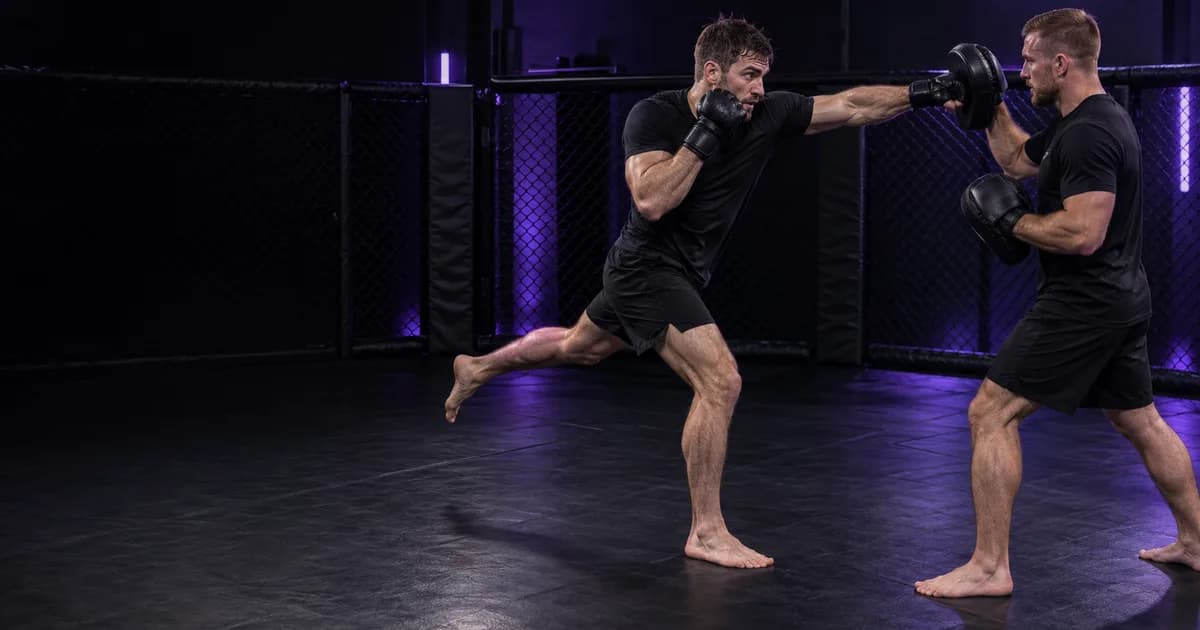
To throw a superman punch, show your opponent a believable rear kick, lift that knee again, hop forward from your lead foot, drive the rear leg behind you, and send your rear-hand cross into the opening. Keep your lead hand at your cheek and recover your rear foot into stance before you add another attack. The strike works when your feint fits a reaction you have already earned. No setup prevents every counter.
Throw the rear-hand superman punch step by step
Treat the technique as a disguised cross, not a high jump. Kickboxer Gabriel Varga's video breakdown shows the tactical sequence: establish the low kick, watch the opponent check it, then replace the next kick with the punch. Rafael Cordeiro's illustrated coaching sequence shows the striker hopping on the lead leg while he drives the rear leg back and throws the rear-hand punch.
| Phase | What you do | What you check |
|---|---|---|
| Show | Throw a controlled rear kick that your partner can read and defend | You return to stance without rushing the next action |
| Sell | Lift the same rear knee with the same early posture and tempo | You keep the same hand position and gaze |
| Drive | Hop forward from the lead foot as you push the rear leg back | You travel across the floor instead of jumping high |
| Cross | Rotate your hip and shoulder into a straight rear hand | You keep your lead glove at your cheek and tuck your chin |
| Recover | Bring the rear foot back under you and rebuild your stance | You can stop, defend, or angle out without an extra balancing step |
Start from a stance you can recover
Begin at the edge of your normal punching range. Distribute your weight so you can move from either foot. If you lean far over the lead knee before the feint, you shorten your hop and tell your partner that a forward attack has started.
Choose a distance that lets you punch the mitt without locking your elbow or falling into the holder. Ask a qualified striking coach to set that distance and inspect your stance before you add speed.
Sell the rear kick before you change the attack
First, give the feint something to imitate. Throw the rear kick with control during earlier exchanges or pad repetitions. Notice what your partner actually does. They may check, brace, step away, catch, or ignore it.
When you see a repeatable reaction, lift the rear knee again with the same early movement. Do not exaggerate the chamber to make the punch look dramatic. Varga stresses the fake that comes before the punch and shows why an opponent who expects a plain jab can read an unsupported entry.
Drive the rear leg back as you send the cross
Once you lift the rear knee, you cannot push forward from that foot. Hop from the lead foot, travel forward rather than upward, and drive the rear leg behind you as you rotate the rear shoulder. Drive the leg back and send the cross on the same beat.
Keep the lead glove near your cheek. Aim straight through the center of the mitt. If you swing the hand around the pad, you turn the cross into a looping punch and expose a wider lane for a return.
Land ready to defend
Land the small hop on the lead foot, then return the rear foot to a stance you recognize. Keep enough space between your feet to turn, sprawl, or frame. Do not admire the punch or leave the rear leg behind you after contact.
Ask the holder to move the mitt closer if you need a long leap to reach it. A balanced landing matters more than extra distance. Finish each early repetition by freezing in stance, checking your guard, and then resetting.
Time the punch against a reaction you have earned
The superman punch works best when the feint and the punch share a believable history. Varga's coaching example starts with repeated kick information and draws a check before he changes the attack.
Use this decision sequence:
- Show the rear kick under controlled conditions.
- Watch whether your partner repeats a clear defense.
- Match the beginning of your feint to the beginning of the real kick.
- Start the cross as your partner commits attention or balance to that defense.
- Recover and leave the exchange instead of assuming the punch ended it.
Match the feint to your opponent's rhythm, not to a count in your head. If they repeatedly settle, check, or shift weight at the same point in your kick, begin the feint on that familiar beat and send the cross only after their response starts. Abandon the entry if their rhythm changes before you commit.
Do not treat one reaction as a permanent habit. Combat-sport athletes learn to anticipate attacks from movement information, and experienced athletes generally respond more accurately and quickly than less experienced athletes, according to a systematic review of 27 combat-sport studies. That evidence supports training your timing against a live visual response. It does not prove that one feint will fool a particular opponent.
If your partner never reacts to the kick, choose another setup. You can also delay the technique until you establish the kick more convincingly. Do not make the hop bigger to compensate for a feint that your partner does not respect.
Expect the counters your airborne entry invites
No setup prevents every counter. You travel forward on a line while you take your rear foot away from its normal base. If your opponent reads the knee lift, they may create distance, angle away, cover and return a straight punch, close into a clinch, or change levels as you recover.
Treat these responses as coaching possibilities, not guaranteed outcomes. Your stance, the opponent's stance, cage position, distance, and rule set change the exchange.
| Your partner's response | What it exposes | What you practice |
|---|---|---|
| Steps straight back | You may reach and fall short | Shorten the hop, land in stance, and stop the exchange |
| Angles outside the cross | You may keep traveling past the target | Turn only after both feet support you |
| Covers and sends a straight return | Your punch-side guard may recover late | Bring the rear glove home and leave your lead glove at your cheek |
| Closes into a clinch | You may land upright and expose your hips | Recover posture and frame before you throw again |
| Changes levels | You may travel over the entry | Land ready to sprawl or frame |
You avoid many predictable counters by earning the feint, limiting the hop, protecting your lead side, and recovering before you continue. You never remove every counter. Train the partner's response instead of rehearsing a guaranteed finish.
Build the entry through three partner drills
Use a qualified coach, a clear mat, suitable gloves, and correctly held focus mitts. Keep early contact on the pad, not your partner's head. Agree on speed, contact, allowed responses, and a stop signal before every drill. The beginner MMA sparring guide gives you a fuller constraint checklist for controlled rounds.
Drill the slow pad catch and balanced landing
Have the holder present one mitt at cross height while standing outside your punching range. Lift the rear knee, hop only far enough to touch the mitt, extend the rear leg behind you, and land in stance. Keep the punch light.
After contact, freeze long enough for your coach to check three details: you guard with the lead hand, keep your head over your base, and return the rear foot to a useful position. Reset if you need a second step to catch your balance. Film from the side only after the athletes and equipment can move without hitting the camera.
Add the real kick and the visual choice
Have the holder give you two coached cues. On the first cue, throw the controlled rear kick to a suitable pad. On the second, show the same knee lift and change to the superman cross on the focus mitt. Keep the first movement similar enough that the choice appears after the chamber, not before it.
Next, let the holder choose which pad to present. Respond to what you see. Do not guess a sequence. If either person loses the pad position or balance, lower the speed and restore the fixed pattern.
Enter controlled sparring one response at a time
Start a constrained round at technical pace. The attacker may use the established rear kick or the superman punch. The defender may only cover or step back. The attacker touches the agreed glove or body target, recovers stance, and exits. Reset after each exchange.
When both athletes keep control, let the defender add one coached response after the entry, such as a straight touch, an angle, a clinch connection, or a level-change touch. The attacker succeeds by landing balanced and making the first safe defensive decision, not by forcing the punch through.
Keep the pad work and sparring controlled
Do not learn this strike through hard head contact. A forward hop reduces your ability to change direction after you commit, and an unstable landing can carry you into the holder or another athlete. Clear the landing area, keep the camera outside the training space, and stop when either person loses control.
Stop the session after a concerning head impact, confusion, dizziness, worsening headache, balance trouble, unusual behavior, or any suspected injury. Seek urgent medical help for danger signs. The CDC concussion guidance explains what athletes and coaches should watch for, and the CDC says an athlete should return to sport only with healthcare-provider approval and supervision after a concussion.
Ask a qualified coach to supervise your progression from pads to partner timing. Ask a qualified clinician to assess pain, suspected concussion, or injury. A video review cannot clear you to continue training.
Confirm the strike under your event rules
The current ABC Unified Rules of MMA treat legal punches as scoring strikes and do not list a superman punch as a foul. That supports a narrow conclusion: a superman punch counts as a legal strike when you use a closed fist, hit a legal target, and follow the applicable rules. The rules still prohibit strikes to the back of the head or spine, groin attacks, eye gouging, and fingers extended toward an opponent's face.
The IMMAF 2025 amateur rules also discuss legal punches while applying different restrictions by age and competition category. Neither document names the superman punch as its own technique, so the legal conclusion comes from the permitted-strike language and foul lists. Your commission, promoter, referee briefing, gym rules, and athlete category can impose different limits. Confirm the rules for your event before you compete.
Answer common superman-punch questions
How do you throw a superman punch?
Establish a rear kick, lift the same knee as a feint, hop forward from your lead foot, drive the rear leg back, and throw your rear-hand cross. Keep your lead glove at your cheek and recover the rear foot into stance.
When does the superman punch work?
Use it after your opponent has shown a repeatable response to the rear kick, especially when the kick chamber draws their attention, guard, or balance away from the cross line. If they do not react, use another setup.
How do you avoid the counter?
You cannot avoid every counter. Earn the feint, keep the hop low and short, protect your lead side, land balanced, and practice one defensive response at a time with a qualified coach.
Is the superman punch legal in MMA?
Yes, under the current Unified Rules, when you throw it as a legal punch to a legal target. Confirm the exact rule set for your event because amateur categories and local commissions may apply additional restrictions.
Check your next repetition
- Show a real kick before you ask the feint to work.
- Match the first part of the feint to the kick.
- Push the rear leg back as the rear cross travels forward.
- Keep your lead glove at your cheek.
- Recover your rear foot before you attack or defend again.
Review the sources
- ABC Unified Rules of MMA, August 2026
- IMMAF Amateur Fouls and Competition Guidelines, June 2025
- Coach Rafael Cordeiro demonstrates the hop, rear-leg drive and punch
- Gabriel Varga breaks down the feint and follow-up
- Systematic review of perceptual anticipation in combat sports
- CDC concussion signs and symptoms
- CDC return-to-sports progression