
Training guide
MMA vs Muay Thai: Which One Fits Your Goals
Compare MMA and Muay Thai by rules, scoring, allowed techniques and injury research, then pick the one that fits your goal and your first month.
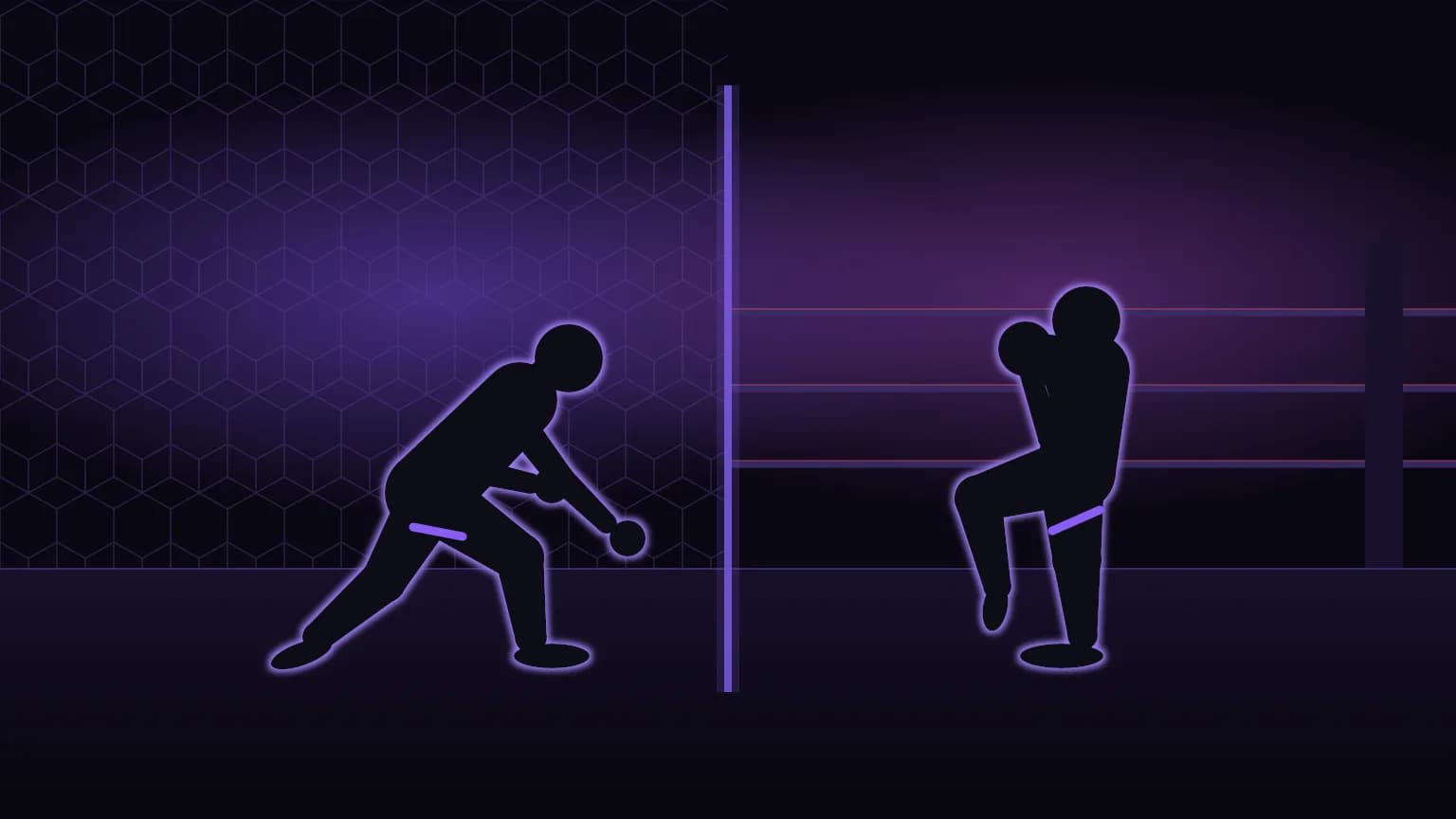
Muay Thai is a stand-up sport: you punch, kick, knee, elbow and clinch, and the rules punish most takedowns. MMA keeps all of those strikes and adds takedowns, ground fighting and submissions, so you start Muay Thai to master striking and MMA to fight in every range.
Below, you get both rulebooks side by side, the research on injuries in each sport and a short list that maps your goal to a first class. You also get four mistakes beginners make when they pick between the two.
Compare the rules side by side
The table reads the ABC Unified Rules of MMA (August 2026) against the IFMA Muaythai Rules and Regulations (May 2026), the federation behind amateur Muay Thai. Professional Muay Thai promotions in Thailand and abroad use their own rulebooks, so check yours before you sign a bout.
| Question | MMA (Unified Rules) | Muay Thai (IFMA, elite division) |
|---|---|---|
| Round length | 5 minutes, 1 minute rest, up to 5 rounds | 3 rounds of 3 minutes |
| What scores | Effective striking and grappling first, then effective aggressiveness, then control of the fighting area | Punches, kicks, knees and elbows that land with force and intent |
| Takedown | Legal. Any throw with an arc is legal, a pile driver is a foul | Fouled when you tackle, throw with the hip or sweep without a strike. A throw earns no points |
| Ground | Fighters continue on the ground until the referee stands them up | A knockdown brings a count to ten. Striking a downed or rising opponent is a foul |
| Submissions | Legal | Locking or hyperextending a joint is a foul |
| Clinch | Legal for strikes, takedowns and control | Legal for knees and elbows. Pushing a held leg more than two steps without a strike is a foul |
| Elbows | Legal. The 2023 text fouls the 12 to 6 elbow and the August 2026 text no longer lists it | Legal with no restrictions in the elite division |
| Knees | Legal, except to the head of a grounded fighter | Legal with no restrictions in the elite division |
| Arena | Cage or ring | Ring |
| Pro glove weight | At least 4 oz, generally 6 oz or less | 10 oz (284 g) |
Two rows matter most. In MMA, grappling earns points and wins fights. In Muay Thai, a throw earns nothing, so a Muay Thai fighter spends the clinch looking for knees and elbows while an MMA fighter spends it looking for a takedown or the fence.
The rule sets also split on what a referee does with a stalled fight. The Unified Rules tell the referee to stand fighters up when neither shows "real, significant and/or sustained effort" to finish. IFMA referees call "yaek" to break a clinch and both fighters step back. Neither rulebook lets you rest on a position.
Check the exact glove weight for your bout with the MMA glove size calculator, and read how MMA rounds, fouls and decisions work before your first card. The legal strike checker answers "is this strike legal" for a given position.
See which techniques overlap
You do not start from zero in one sport when you switch to the other. The strikes carry over. The grappling does not.
| Skill | In Muay Thai | In MMA | What changes when you switch |
|---|---|---|---|
| Punches and kicks | Core | Core | MMA adds a defense against the level change, so you keep your hips back |
| Knees and elbows | Core, scored | Legal, scored by damage | You aim them at a fighter who can also shoot for your legs |
| Clinch | Knees, elbows, off-balancing | Wall work, takedowns, control | You grip differently because the other fighter can take you down |
| Takedowns and sprawls | Not trained for points | Core | You learn them from scratch |
| Ground work | Not part of the sport | Core | You learn positions and escapes from scratch |
| Submissions | Fouled | Core | You learn them from scratch |
The grappling side of MMA is not a small add-on. Dos Santos and colleagues tracked 845 UFC rounds and measured median standing combat time at 2 minutes 10 seconds in an earlier sample and 1 minute 56 seconds ten years later. Both are less than half of a 5-minute round. Ma and colleagues analysed 8,461 UFC bouts from 1997 to 2025. Winners landed a median 0.067 takedowns per minute against 0.000 for losers, and a 50% takedown success rate against 20%. The authors call these descriptive figures and warn against reading them as proof that takedowns cause wins. They still show you that a fighter who ignores the ground leaves a scoring route open to the other side.
The striking side matters just as much. The same rules that foul most throws give Muay Thai a deep stand-up system, with a clinch built for knees and elbows. When you fight MMA, that system is legal.
Read the injury research with its limits
Both sports hit hard, and neither set of studies is clean. The table lists what each paper measured so you can compare like with like.
| Study | What it measured | Result |
|---|---|---|
| Doherty, Barley and Fortington, 2025 | 175 Australian MMA and Muay Thai competitors across 26 events, health problems per 100 minutes of competition | MMA 20.1 (95% CI 16.5 to 24.4), Muay Thai 25 (95% CI 22.3 to 28). The worst problems took a median 20 days to resolve in MMA and 16 in Muay Thai |
| Lystad, Gregory and Wilson, 2014 | Meta-analysis of 6 MMA studies | 228.7 injuries per 1,000 athlete-exposures. Head injuries made up 66.8% to 78.0% of injuries |
| Zachovajevas et al., 2025 | Systematic review of 43 MMA reports after the Unified Rules | 23.6 to 54.5 injuries per 100 athlete-exposures. Concussion 14.7 to 16.1 per 100 |
| Strotmeyer et al., 2016 | Survey of 195 Muay Thai fighters | 55.4% reported an injury in their latest fight. 58% of injuries hit the extremities and 5.4% were concussions |
| Hallaçeli et al., 2025 | 663 athletes examined by a ringside doctor at official Muay Thai bouts | 91.4% had no health issues after the bout. Referees stopped 24.58% of contests |
| Gartland, Malik and Lovell, 2001 | Interviews with 152 Muay Thai practitioners in the UK and Holland | Lower-limb injuries were the most common, and head injuries came second in amateurs and professionals |
Read the table with three rules.
- Trust the Doherty row for a direct comparison. It used one questionnaire, one region and one exposure measure for both sports. The confidence intervals overlap, so you cannot say one sport hurts more.
- Do not line up rates from different studies. A rate per 1,000 athlete-exposures, a rate per 100 minutes and a percentage of fighters measure different things.
- Watch the injury pattern. MMA research reports mostly head injuries, lacerations and concussions. Muay Thai research reports many extremity and lower-leg injuries, which fits a sport built on kicks and checks.
Your own risk depends more on your training than on the label. Sparring at a controlled pace with a coach, protective gear and a stop rule gives you far fewer injuries than hard rounds every session. See a physician before you start if you have a heart, neck, back or concussion history, and stop any session after a head knock.
Pick the one that fits your goal
Use this table to choose your first class. You can add the second sport later, and most serious fighters do.
| Your goal | Start with | Why |
|---|---|---|
| Compete in amateur MMA | An MMA class, or Muay Thai plus wrestling | The Unified Rules score grappling, so you need striking and takedown defense from week one |
| Learn to strike and compete in a ring | Muay Thai | IFMA scores strikes only, so every class trains what the judges count |
| Get fit with a sport you can spar | Whichever gym coaches you best | Both sports give you pad work, bag work and conditioning |
| Defend yourself | MMA, then add clinch and striking work | You train against takedowns as well as strikes. See which martial art fits self-defense |
| Fight in Thai-rules events | Muay Thai | MMA gloves, rounds and clinch rules differ |
| Use kicks and knees in MMA later | Muay Thai first | Every Muay Thai strike is legal in MMA |
Ask any gym these five questions before you sign.
- Who coaches the beginner class, and how many years have they coached?
- How many rounds of sparring do beginners do in month one?
- Does the gym teach the clinch, takedown defense and ground work, or only the strikes?
- Who supplies gloves, shin guards and mouthguards, and what sizes do they stock?
- What is the stop rule when someone gets hurt?
The beginner guide to starting MMA walks you through gym choice, gear and a 12-week plan.
Is Muay Thai good for MMA?
Yes, if you add grappling. Every Muay Thai weapon is legal in MMA: punches, kicks, knees, elbows and clinch strikes. The Unified Rules ban only a short list of strikes, including the back of the head, the spine, the throat and kicks or knees to the head of a grounded fighter. Muay Thai gives you the stand-up half of the sport.
It gives you nothing on the other half. You need sprawls, wrestling and ground work, and the Unified Rules score those actions. An MMA fighter with excellent Muay Thai and no takedown defense loses the round when the other fighter shoots and holds.
Build your stance for both. A stance that stays too upright gets taken down, and one that sits too low gives up your kicks. The MMA stance guide shows you how to balance striking, takedown defense and movement. The calf kick guide breaks down a low kick that MMA fighters use at a distance, and shows you how to check it.
Fix four mistakes beginners make
- You pick by highlight reel. A knockout clip tells you nothing about the class you will sit in. Visit both gyms, watch a beginner class and pick the coach you trust.
- You spar hard in month one. Both sports hurt fastest in sparring. Ask for light, technical rounds until your coach says you can defend yourself.
- You train only the half you like. If you start with Muay Thai and want MMA, book wrestling by month three. If you start with MMA, keep one striking session a week going.
- You buy gear before you check the rules. MMA gloves run 4 to 6 oz in pro rules and Muay Thai gloves run 10 oz. Use the glove size calculator and ask your gym what it requires.
Review your rounds with MMA AI: Cage Coach
Get quick answers
Is Muay Thai or MMA better for beginners?
Neither wins on its own. Pick the gym with the better coach and the better beginner class. Muay Thai gives you a simpler first month because you learn one range, while MMA gives you three ranges and more to learn at once.
Is Muay Thai harder than MMA?
They ask for different things. Muay Thai asks for deep technique in one range, with a clinch built around knees and elbows. MMA asks you to cover striking, wrestling and the ground in one sport.
Can Muay Thai fighters do MMA?
Yes. Every Muay Thai strike is legal in MMA. You need to add takedown defense, wrestling and ground work, because the Unified Rules score grappling.
Which sport has more injuries?
The one study that measured both with the same method found overlapping results: 20.1 health problems per 100 competition minutes in MMA and 25 in Muay Thai. Studies of each sport alone use different measures, so you cannot rank them from those numbers.
Should I do Muay Thai before MMA?
You can start with either. If you want to fight MMA, add wrestling and ground work early. If you want to fight in a ring under Muay Thai rules, stay with Muay Thai and add MMA only for fitness.
Are elbows legal in MMA?
Yes. The August 2026 Unified Rules text no longer lists the 12 to 6 elbow as a foul, and your commission decides which edition applies. Check your commission's version before your bout.
Check the sources
- ABC Unified Rules of MMA, August 2026
- ABC Unified Rules of MMA, 2023 text
- Unified Rules of MMA, gloves section, UFC-hosted PDF
- IFMA Muaythai Rules and Regulations v3.057, May 2026
- Doherty, Barley and Fortington, Sports Medicine Open 2025
- Lystad, Gregory and Wilson, Orthopaedic Journal of Sports Medicine 2014
- Zachovajevas et al., Orthopaedic Journal of Sports Medicine 2025
- Strotmeyer et al., Injury Epidemiology 2016
- Hallaçeli et al., Injury Epidemiology 2025
- Gartland, Malik and Lovell, British Journal of Sports Medicine 2001
- Dos Santos et al., International Journal of Sports Physiology and Performance 2019
- Ma et al., BMC Sports Science, Medicine and Rehabilitation 2026