Technique
MMA Moves List: Names, Cues and Rules for Beginners
Learn the core MMA moves by range: strikes, clinch, takedowns, ground positions, submissions and escapes, each with one cue and the rule that limits it.
MMA moves sort into six groups that follow the ranges of a fight: strikes, clinch work, takedowns, ground positions, submissions and escapes. As a beginner, learn the names below one range at a time, starting with the jab, cross, teep, sprawl, double-leg, closed guard, elbow-knee escape and rear-naked choke.
Every table gives you the move, one cue to drill it and the rule that limits it, from the ABC Unified Rules of MMA for pro bouts and the amateur rulebooks you meet first. Fight studies show you which moves end real fights.
See the four ranges on one map
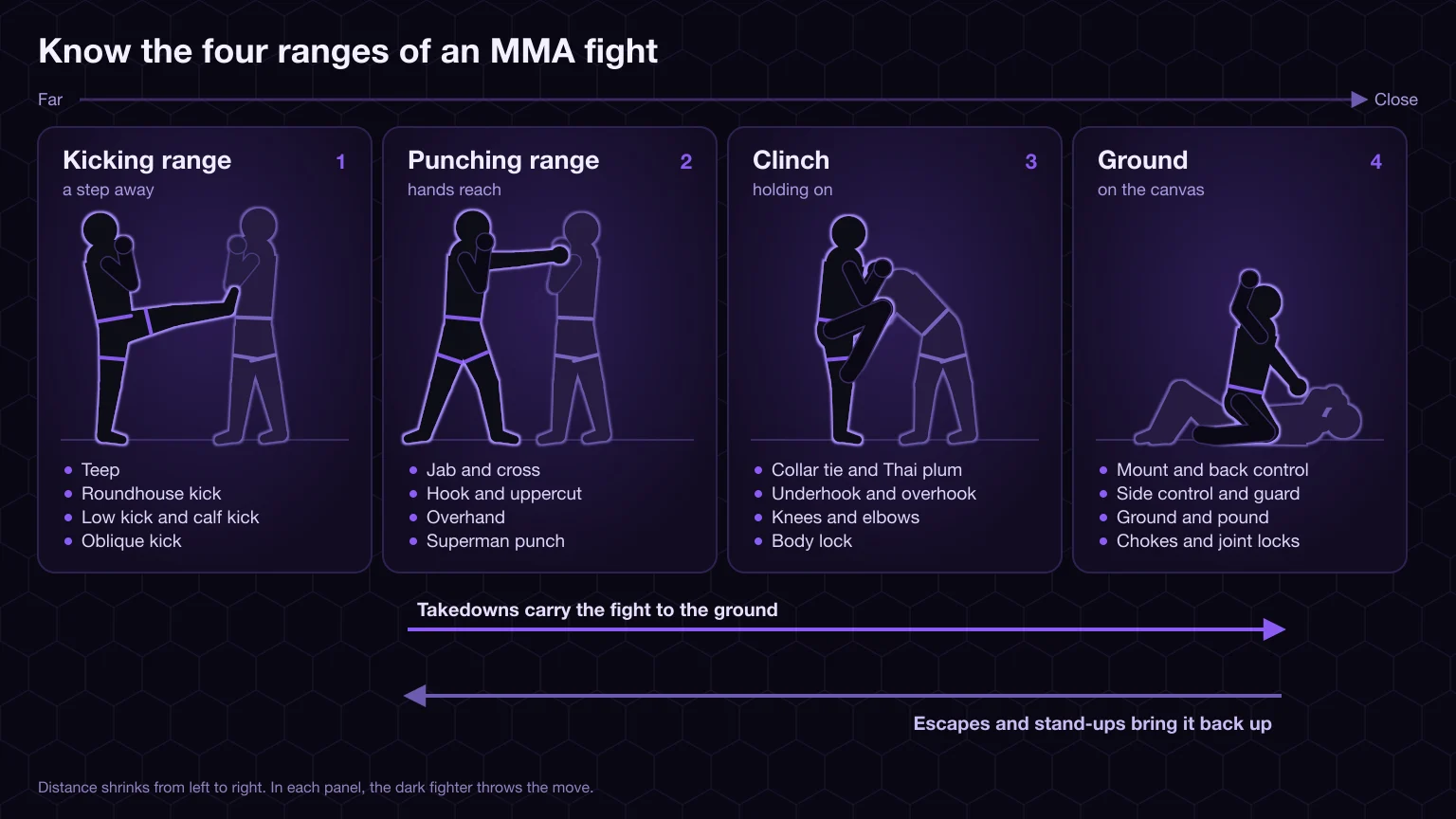
A fight moves through four distances. At kicking range you need a step to land a punch. At punching range your hands reach without a step. In the clinch you hold the head, arms or body. On the ground at least one of you has a knee, hip or back on the canvas. Takedowns carry the fight down, and escapes and stand-ups bring it back up.
You need every range because fights end by strikes, by submissions and on the scorecards. Mańka-Malara and Trzaskowski read 2,471 UFC results from numbered events between 2000 and 2021: 35.8% ended by knockout or technical knockout, 18.7% by submission and 45.5% went to the judges. Across 8,461 UFC bouts, winners landed a median 50% of their takedown attempts and losers 20%. The authors warn that the figure describes winners and does not prove that takedowns cause wins.
Learn the strikes
You throw strikes at kicking and punching range, and some of them in the clinch and on the ground. Start with straight punches and one kick, then add the rest.
| Move | What it is | Your cue | Rule note |
|---|---|---|---|
| Jab | Straight punch with your lead hand | Lift your lead shoulder to cover your chin as the hand goes out | Legal to the head and body |
| Cross | Straight punch with your rear hand | Turn your rear foot and hip as the hand goes out | Legal to the head and body |
| Hook | Bent-arm punch on a level path | Keep your elbow level with your fist and turn on the ball of your foot | Legal |
| Uppercut | Rising punch to the chin or body | Bend your knees a little and drive up from your legs | Legal |
| Overhand | Looping rear hand over the top of the guard | Roll your head off the center line as the hand loops over | Legal |
| Superman punch | Cross thrown off a fake rear kick | Chamber your rear knee, kick the leg back and throw with it | Legal |
| Hammerfist | Strike with the bottom of your fist, mostly from top position | Sit tall and hit with the meat of the fist | Never to the back of the head or spine |
| Teep | Push kick with the ball of your foot to the stomach or thigh | Lift your knee first, then push your hips through | Legal |
| Roundhouse kick | Shin kick to the leg, body or head | Pivot on your support foot so your heel turns toward the target | Kicks to the head of a grounded fighter are fouls |
| Low kick | Roundhouse to the thigh | Land your shin on the middle of the outer thigh | Legal |
| Calf kick | Roundhouse to the calf of the lead leg | Kick when the other fighter's weight sits on that leg | Legal |
| Oblique kick | Heel kick to the thigh just above the knee | Turn your foot out and drive the heel straight in | Legal in pro rules; ABC amateur rules ban linear kicks to the knee joint |
| Horizontal elbow | Short elbow across your body | Keep the striking hand open by your ear and turn your hips through | Legal in pro rules; ABC and IMMAF amateur rules ban every elbow |
| 12 to 6 elbow | Straight downward elbow from top position | Keep your base wide before you lift the elbow | Legal under the current Unified Rules; amateur rules ban it |
| Straight knee | Knee driven forward to the body or head | Pull the head down and push your hips forward | No knee to the head of a grounded fighter; amateur rules ban knees to the head |
The calf kick guide shows you how to throw the calf kick and how to check it.
Two rules shape every strike on this list. First, you may never hit the back of the head, the spine or the groin, or butt with your head. Second, you may never knee or kick the head of a grounded fighter. Since the July 2024 amendment the Unified Rules call you grounded when any part of your body other than your hands or feet touches the canvas, so a fighter with both hands down and both feet on the mat can take a knee to the head. The 2023 text counted you as grounded with anything other than the soles of your feet bearing weight, and it fouled the 12 to 6 elbow. The August 2026 text lists no 12 to 6 foul. Your commission still decides which edition applies, so run any strike and position through the MMA legal strike checker before a bout.
Win the clinch
The clinch starts when you grab the head, an arm or the body. Here you strike short, push the other fighter to the fence or set up a takedown.
| Move | What it is | Your cue | Rule note |
|---|---|---|---|
| Single collar tie | One hand behind the head | Cup the back of the head and lay your forearm on the collarbone to block punches | Legal |
| Double collar tie (Thai plum) | Both hands behind the head | Stack your hands, squeeze your elbows together and pull the head down | Knees from here follow the knee rules |
| Underhook | Your arm under their armpit | Drive your arm deep, palm on their back, head on the same side | Legal |
| Overhook | Your arm over their underhook | Clamp the arm to your ribs and turn your hip into them | Legal |
| Body lock | Your hands locked around the waist | Lock low at the hips with your head tight to their chest | Legal |
| Dirty boxing | Short punches while you control the head or a wrist | Hold the head or wrist and throw short hooks and uppercuts | Legal |
Short punches from the tie get their own guide: dirty boxing in MMA. Two clinch fouls catch beginners. You may push off the fence, and your toes may go through it, but grabbing the fence with your fingers or toes to control a position is a foul. You may grip the other fighter's hand, but holding the shorts or the gloves by the material is a foul.
Hit and stop takedowns
A takedown moves the fight from standing to the ground. A takedown defense keeps it standing.
| Move | What it is | Your cue | Rule note |
|---|---|---|---|
| Double-leg | Shot at both legs | Drop your hips before your hands reach, step deep and drive through with your head up | Legal |
| Single-leg | Shot at one leg | Hug the leg to your chest with your head inside, then turn the corner | Legal |
| Body lock takedown | Takedown from a waist lock | Lock around the waist, step behind their leg and drop your weight to that side | Legal |
| Outside trip | Reap of the leg from the outside | Push their upper body back over the heel you reap | Legal |
| Hip throw | Throw over your hip | Turn your hips in front of theirs and pull them over | Legal while the throw keeps an arc |
| Ankle pick | Grab of the heel as they step | Snap the head down to make them step, then pick that heel | Legal |
| Sprawl | Defense against a shot | Shoot your legs back, drop your hips on their shoulders and keep your head up | Legal |
Your first shot is the double-leg takedown, and your first defense is the sprawl. Once you hold the clinch, the body lock takedown gives you a finish against the fence. The Unified Rules allow any throw with an arc, even when the head hits the canvas. They foul spiking a fighter onto the head or neck, the pile driver. ABC amateur rules also list suplexes onto the head or neck as illegal spiking.
Know the ground positions
Ground positions rank from best to worst for the fighter on top. Miarka and colleagues found that winners in 645 rounds of MMA competition made more positional improvements, such as advances to mount, side control and the back, than the fighters they beat.
| Position | What it is | Cue on top | Rule note |
|---|---|---|---|
| Back control | You sit behind them with your heels hooked inside their thighs | Keep your chest on their back and one arm over the shoulder, one under | No strikes to the back of the head or spine |
| Mount | You sit on their hips with your knees on the mat | Keep your knees tight to their hips and your weight low | Punches and elbows to the face are legal in pro rules |
| Side control | You lie chest to chest across their body | Keep your hips low and your chest heavy | Knees to the body are legal; knees to the head are fouls |
| Knee on belly | Your knee across their stomach, far leg posted | Post the far leg wide and keep the knee on the belly button | Same as side control |
| Turtle | They kneel on knees and elbows | Take the back or stay heavy on top | The fighter on knees counts as grounded: no knees or kicks to the head |
| Half guard | They trap one of your legs | Flatten them with a crossface before you pass | Legal |
| Closed guard | You kneel between their legs, ankles crossed behind you | Sit tall with your hands on their hips | Upkicks may reach your head only when just your hands and feet touch the mat |
Amateur rules tighten the ground game. In an ABC novice bout, for fighters with fewer than three bouts, any strike to the head of a grounded fighter is a foul.
Finish with submissions
A submission ends the fight when the other fighter taps or the referee stops it. Chokes compress the neck. Joint locks bend a joint past its range.
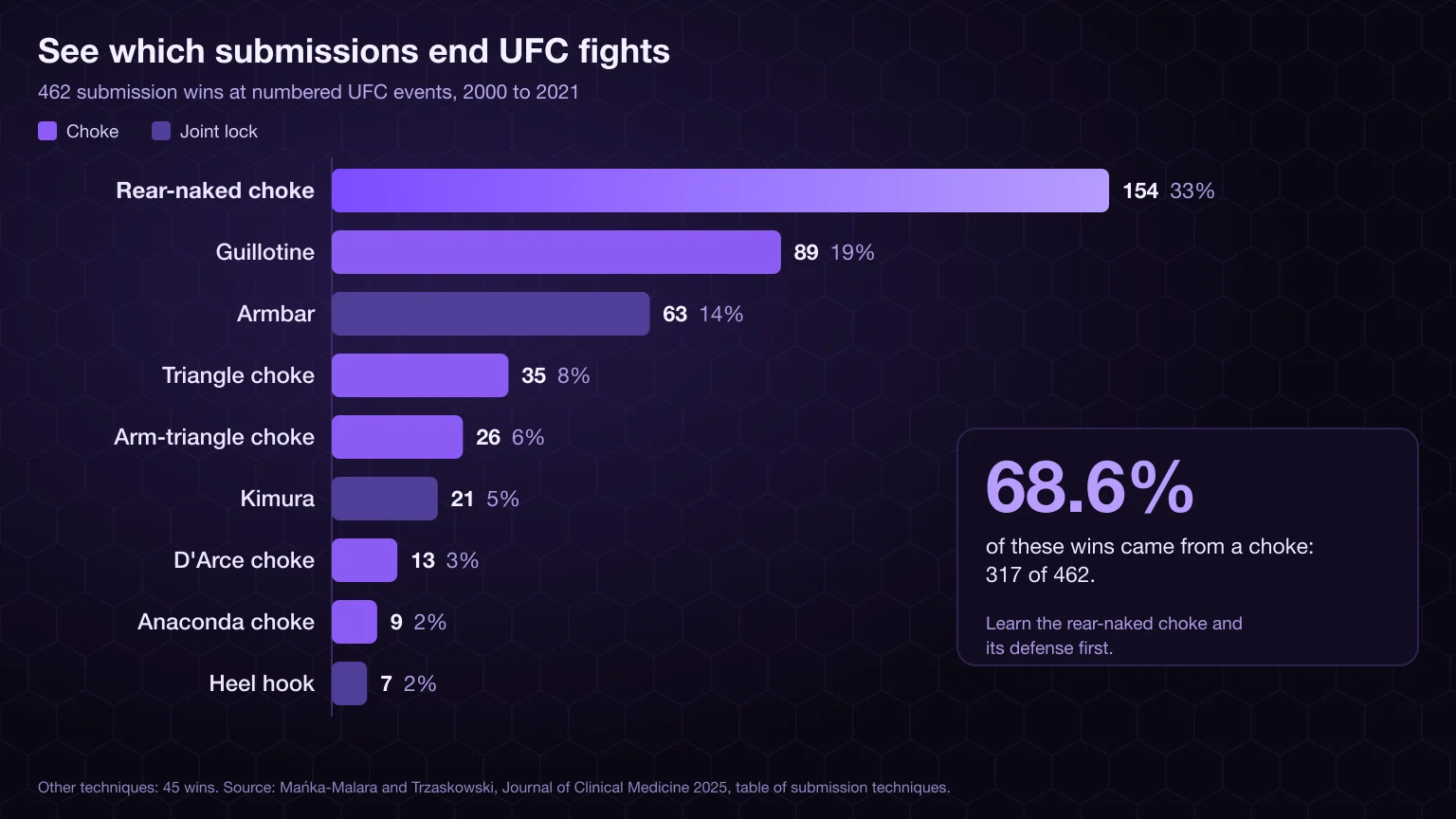
The chart comes from the submission table of the same 2,471-fight study. The rear-naked choke ended 154 of 462 submission wins, a third of them, and chokes of every kind ended 317, or 68.6%. In a separate count of 904 fight-ending chokes across UFC history, Stellpflug and colleagues found the rear-naked choke in 49.1% of them. Fares and colleagues found a submission rate of 19.8% across 3,123 UFC pay-per-view fights.
| Submission | What it attacks | Your cue | Rule note |
|---|---|---|---|
| Rear-naked choke | Neck, from back control | Slide your arm under the chin, grab your own biceps and put your other hand behind their head | Legal in pro and amateur rules |
| Guillotine | Neck, from the front | Wrap the neck with your forearm under the chin, lock your hands and lift with your hips | Legal |
| Armbar | Elbow | Pinch your knees, keep their thumb up and lift your hips into the elbow | Legal |
| Triangle choke | Neck and one arm, with your legs | Lock a figure four with your legs around the head and arm, then cut an angle | Legal |
| Arm-triangle choke | Neck and one arm, with your arms | Drop your shoulder into the neck and walk to the side | Legal |
| Kimura | Shoulder | Hold the wrist, lock a figure four with your other arm and turn the hand behind the back | Legal |
| D'Arce choke | Neck and arm, from the front | Thread your arm under their arm and neck, lock on your biceps and squeeze | Legal |
| Straight ankle lock | Ankle | Trap the foot under your armpit and arch your hips | ABC amateur rules allow it |
| Kneebar | Knee | Pinch the leg between yours and extend your hips | ABC amateur rules allow it |
| Heel hook | Knee, through a twist of the heel | Learn it with a coach before you use it live | Legal in pro rules; ABC and IMMAF amateur rules ban it |
| Neck crank | Neck, by twisting | Leave it out until you compete under pro rules | IMMAF amateur rules ban it; ABC amateur rules ban it outside one guard exception |
Fingers and toes count as small joints, and the Unified Rules ban small joint manipulation, though you may grab most of the fingers at once. Wrists, ankles, knees, shoulders and elbows count as large joints, so locks on them stay legal in pro bouts.
Escape bad positions
Escapes get you out from under the other fighter or back to your feet. Drill them as hard as the attacks.
| Bad spot | Escape | Your cue |
|---|---|---|
| Under mount | Bridge and roll (upa) | Trap one arm and the foot on the same side, then bridge over your shoulder |
| Under mount | Elbow-knee escape | Push their knee with your elbow, shrimp your hips out and pull your leg back in |
| Under side control | Frame and shrimp | Frame on the neck and hip, shrimp away and slide your knee in |
| Back taken | Two-on-one hand fight | Grab the choking wrist with both hands and slide your shoulders to the mat |
| In their closed guard | Posture up and stand | Keep your hands on their hips, stand tall and open their knees |
| Pinned on the fence | Wall walk | Put your shoulder blades on the fence and walk your feet under you |
| Down in open space | Technical stand-up | Post one hand behind you, lift your hips and swing your leg back under you |
Pick your first ten moves
Learn these ten in this order. Each one covers a range you meet in your first month.
- Jab. It measures distance and starts most combinations.
- Cross. It gives you your power hand from the same stance.
- Teep. It keeps a rushing opponent at kicking range.
- Sprawl. It stops the shot at your legs.
- Double-leg. It gives you one reliable way to take the fight down.
- Underhook. It wins you position in the clinch and against the fence.
- Closed guard. It gives you a safe position from your back.
- Elbow-knee escape. It gets you out from under mount and side control.
- Technical stand-up. It gets you back to your feet without exposing your head.
- Rear-naked choke. It ends more UFC fights than any other submission in the study above.
Drill each move in a coached class before you use it live. Rounds of pads and live grappling burn about 795 kcal an hour at 170 lb, and you can count your own week with the MMA calories burned calculator.
Check your takedown with MMA AI: Cage Coach
Fix four beginner mistakes
- You collect moves and skip the drill. Drill a few moves until they work against a resisting partner, then add more.
- You crank submissions in training. Apply a lock slowly and let go on the tap. In the UFC choke count above, 11% of fight-ending chokes ended with a loss of consciousness.
- You train only the range you like. Train striking, the clinch and the ground every week, or the other fighter takes the fight where you never practice.
- You learn the pro rules and enter an amateur bout. IMMAF amateur rules ban elbows, knees to the head, heel hooks, neck cranks and any submission that puts pressure on the neck or spine. ABC amateur rules ban elbows, knees to the head, heel kicks to the kidneys, linear kicks to the knee, twisting leg locks and spine locks.
Spar light while you learn. In a meta-analysis of MMA injury studies, Lystad and colleagues found that head injuries made up 66.8% to 78.0% of injuries. Wear a mouthguard, agree on the pace with your partner and stop after any knock to the head. See a physician before you start if you have a neck, back or concussion history.
Get quick answers
What are the basic moves in MMA?
Start with the jab, cross, hook, teep and low kick, the collar tie and underhook, the double-leg and sprawl, closed guard and mount, the elbow-knee escape, and the rear-naked choke, guillotine and armbar.
What is the most common submission in MMA?
The rear-naked choke. It ended 154 of 462 submission wins at numbered UFC events from 2000 to 2021, and 49.1% of the 904 fight-ending chokes in UFC history that Stellpflug and colleagues counted.
Are 12 to 6 elbows legal in MMA?
Under the current Unified Rules, yes. The 2023 text fouled the straight downward elbow, and the July 2024 amendment removed that foul. Your commission decides which edition applies, and amateur rules ban every elbow.
Can you knee a grounded opponent in MMA?
You may knee the body of a grounded fighter. A knee to the head of a grounded fighter is a foul, and the Unified Rules call a fighter grounded when any part of the body other than the hands or feet touches the canvas.
Which moves are illegal in amateur MMA?
IMMAF amateur rules ban elbows and forearm strikes, knees to the head, heel hooks, neck cranks and submissions that put pressure on the neck or spine. ABC amateur rules also ban spine locks, linear kicks to the knee and heel kicks to the kidneys, and novice bouts ban strikes to the head of a grounded fighter.
Check the sources
- ABC Unified Rules of MMA, August 2026 text
- ABC Unified Rules of MMA, 2023 text
- ABC Amateur Mixed Martial Arts rules
- IMMAF Unified Rules for Amateur MMA, January 2021
- Mańka-Malara and Trzaskowski, Journal of Clinical Medicine 2025
- Stellpflug, Menton and LeFevere, The Physician and Sportsmedicine 2022
- Fares et al., Journal of Sports Medicine and Physical Fitness 2025
- Ma et al., BMC Sports Science, Medicine and Rehabilitation 2026
- Miarka et al., Journal of Strength and Conditioning Research 2016
- Lystad, Gregory and Wilson, Orthopaedic Journal of Sports Medicine 2014