
Fundamentals
Fix Your MMA Footwork: Steps, Angles and Cage Exits
Move like an MMA fighter: keep your base on every step, pivot off angles, cut off the cage and get off the fence. Drill it by level, then check it on video.
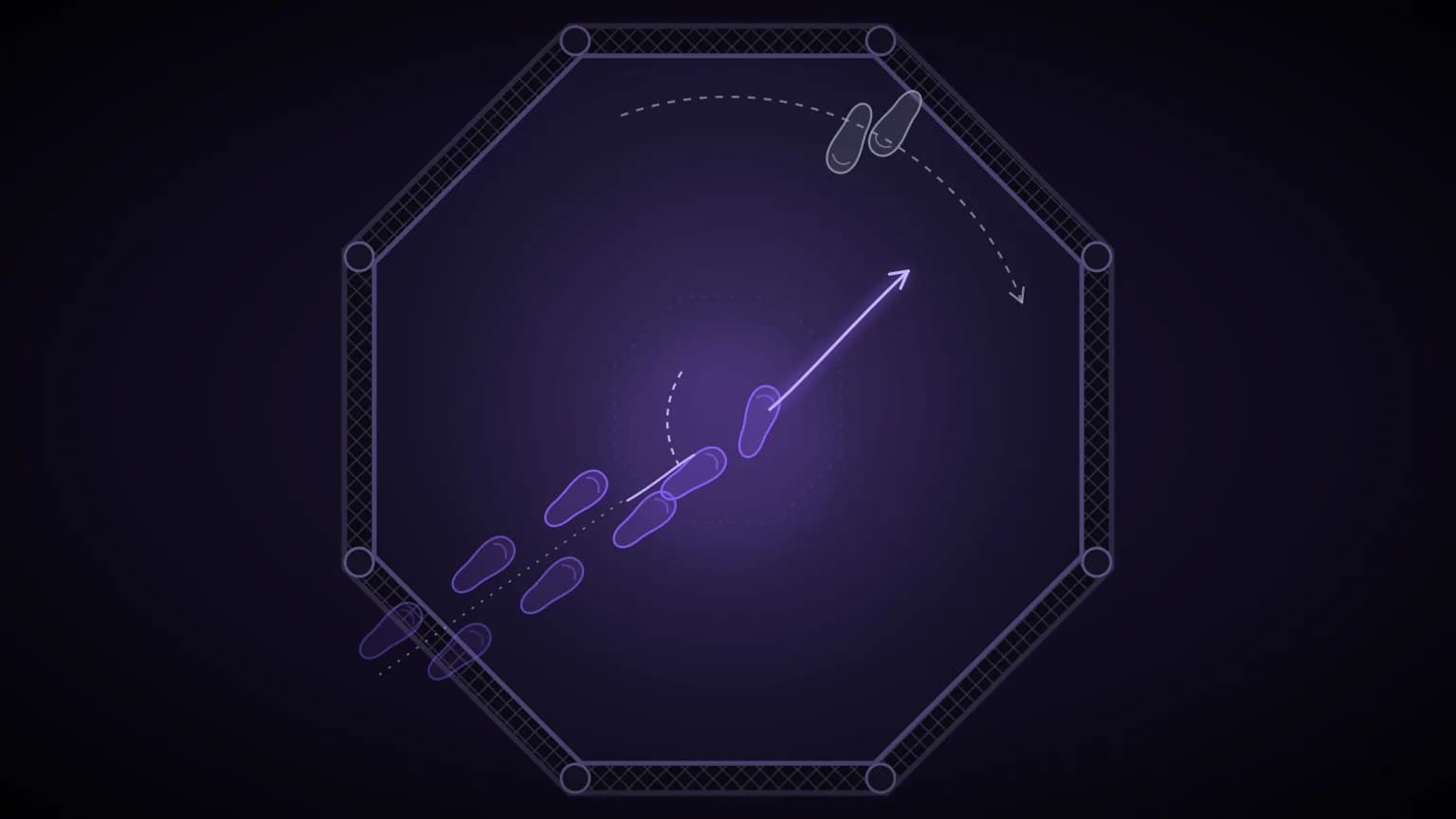
MMA footwork is how you move your stance without losing it: short push steps that keep the same distance between your feet, angle steps and pivots that take you off your opponent's line, and the cage skills of cutting an opponent off and getting your back off the fence. Good footwork lets you strike, sprawl and shoot from the same base on every step.
Footwork decides where every punch, kick and takedown starts. England Boxing's coaching handbook puts it bluntly: effective punching begins with good footwork. MMA adds two problems boxing never has, takedowns and a fence, so you move in a slightly shorter base and you treat the cage as part of the fight.
Set the base you move from
You move well only from a stance you can hold. England Boxing lists the principles: good balance, the ability to move quickly in any direction, a small target, the right width and length between your feet, feet at roughly 45 degrees to your opponent and the rear heel slightly raised. Its list of common errors is your checklist: feet in line, feet too wide, feet too narrow, a flat back heel and a square stance, especially when you move to your right.
For MMA, keep the stance short enough to sprawl and step. The MMA stance guide shows where to put your feet, your hips and your hands. Everything below assumes that base. Your feet decide your range, and the MMA moves list shows the strikes, clinch moves and takedowns that each range opens up.
Move in four directions with the push step
England Boxing's key coaching points for footwork are the core of the push step:
- Forward: push off your back foot and let the front foot step first.
- Back: push off your front foot and let the back foot step first.
- Sideways: push off the foot farther from where you are going and let the near foot step first.
- Every step: keep the same distance between your feet, never cross your legs and never bring your feet together.
Move with short, smooth, sliding steps and minimal bounce. The handbook calls changing direction and tempo the real skill of footwork, so practise stopping, reversing and changing speed as much as moving.
Keep your rear heel off the canvas. A flat back heel roots you, and the handbook warns against that "concrete feet" habit by name.
Take angles off the center line
Straight lines get you hit. Once your push step holds its shape, learn the two ways to leave your opponent's line:
- Angle step. Step your lead foot diagonally forward and outside your opponent's lead foot, follow with the rear foot, then turn your toes back toward your opponent. You arrive at an angle where you can strike and your opponent has to turn before striking back.
- Pivot. Keep your weight on the ball of your lead foot and swing your rear foot around it, a quarter turn at most. Pivot after a combination to exit, or pivot as your opponent charges so the charge passes by.
Match the angle to the threat. Step outside the lead foot against a jab, and pivot away from the power hand when an opponent rushes. When you throw a calf kick, an outside angle also puts your shin on the side of the lead calf.
Cut off the cage
When an opponent circles away, chasing their back is the slowest way to catch them. Cut the cage instead:
- Keep your lead foot roughly in line with your opponent's lead foot so you stay between them and open space.
- Step sideways in the direction they move, with the push step, and do not follow their path.
- Take one step at an angle each time they change direction, so each lap shrinks the space they have.
- Throw a jab, a feint or a low kick as you close, so they must react while their back nears the fence.
Your goal is a position with your opponent's back on the fence and your feet still under you. From there, your takedown entries get shorter. The takedown entries guide shows how to finish that last step.
Get your back off the fence
The fence works for the fighter who controls it. Know the rule first: under the Unified Rules of MMA, you may put your hands on the fence and push off it at any time, and your toes may go through the fencing. Grabbing the fence with your fingers or toes to control your body or your opponent is a foul, and the referee may deduct a point when it has a substantial effect.
Then use one of three exits:
- Pivot out. Frame with your forearm, put your weight on the foot nearer open space and pivot your back away from the fence as you step out.
- Underhook and turn. Win an underhook, step your far foot around and turn your opponent's back to the fence.
- Circle on the push step. Before you are pinned, step off the fence at an angle with the push step instead of backing straight up.
Never back straight up when you feel the fence behind you. Every straight step back costs you space you cannot get back.
Fix the 5 mistakes that cost you rounds
| Mistake | What it costs you | Fix |
|---|---|---|
| You cross your feet | A push or a kick knocks you off balance | Step with the near foot first and keep the gap between your feet |
| You bring your feet together | You lose your base and your sprawl | Keep the same width on every step |
| You bounce high | Your weight leaves the floor when a takedown comes | Slide with short, low steps and minimal bounce |
| You back up in straight lines | You end up on the fence | Step off at an angle or pivot after every exchange |
| You square up moving to your right | Your chin and body face your opponent | Keep your stance angle as you move and check it on video |
Most of these come straight from England Boxing's lists of footwork principles and common stance errors. The straight-line retreat is the MMA version: in a cage, it ends at the fence.
Drill your footwork by level
| Level | Drill | How to run it |
|---|---|---|
| Beginner | Push step lines | Forward, back, left and right across the mat, 4 rounds of 2 minutes, eyes up |
| Beginner | Mirror drill | Your partner moves and you keep the same distance, 3 rounds of 2 minutes |
| Intermediate | Angle and pivot shadow rounds | Throw a short combination, then angle step or pivot out, 4 rounds of 3 minutes |
| Intermediate | Sprawl from motion | Your partner calls "shot" while you move; sprawl, recover your stance and keep moving |
| Advanced | Cage cut-off | Your partner circles away inside the cage while you cut the angle, 3 rounds of 2 minutes each way |
| Advanced | Fence exits | Start with your back on the fence and work pivots and underhook turns at rising resistance |
Add the MMA drills for beginners once the push step holds its shape, and put your footwork rounds on your easy striking days with the MMA training week planner. Sprawl from motion pairs with the sprawl technique guide.
Get quick answers
What is footwork in MMA?
It is how you move your stance: push steps in four directions, angle steps and pivots off your opponent's line, and the cage skills of cutting an opponent off and getting off the fence. Good footwork keeps your base under you so you can strike, sprawl or shoot at any moment.
How is MMA footwork different from boxing footwork?
You use the same push step and the same rule never to cross your feet, but you move in a slightly shorter stance so you can sprawl, and you treat the fence as a weapon and a trap. Boxing never asks you to defend a takedown in the middle of a step.
How do you get off the cage in MMA?
Pivot out with a frame, win an underhook and turn your opponent, or step off at an angle before they pin you. You may push off the fence with your hands, but grabbing it with your fingers or toes to control position is a foul under the Unified Rules.
How can you practise MMA footwork alone?
Run push step lines, then shadow rounds where every short combination ends with an angle step or a pivot. Mark a line on the floor to check that your feet never cross it.